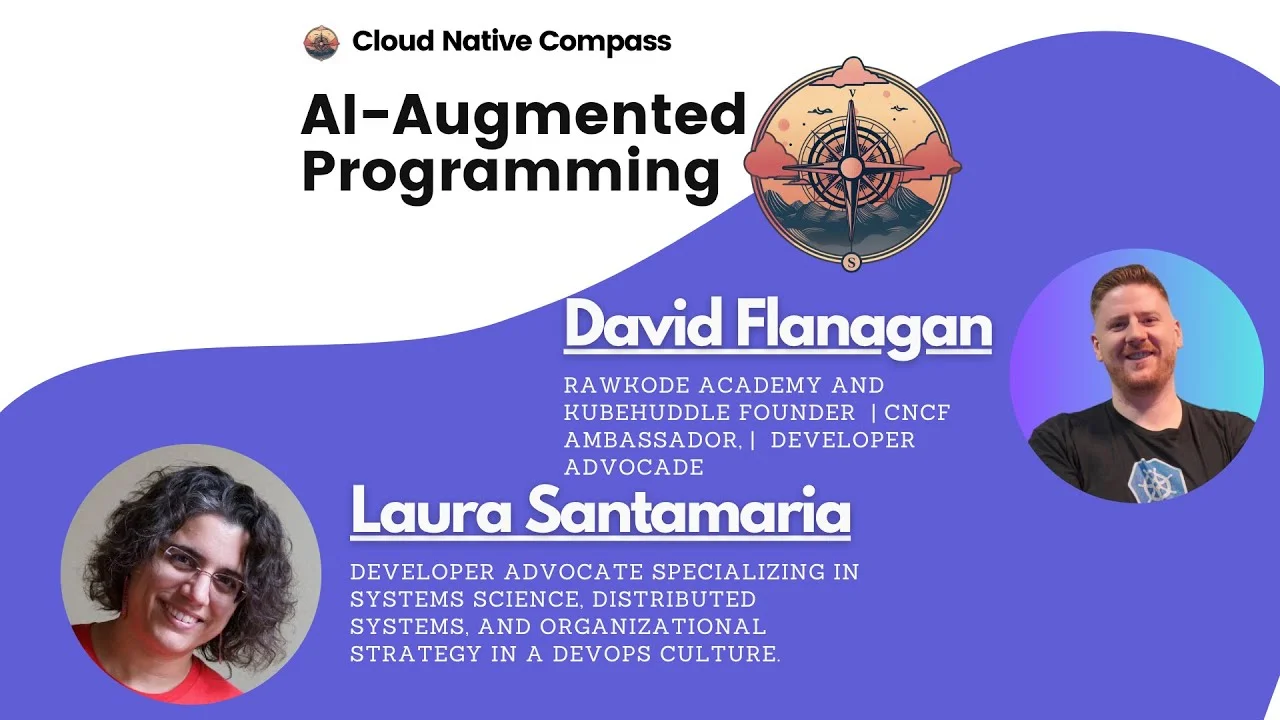
AI-Augmented Programming
- Date
- Runtime
- 41:58
- Share
About this video
What You'll Learn
- How Claude Code works as a CLI agent with terminal access and commits
- How prompts, personas, and architecture constraints guide AI toward usable code
- How to balance productivity gains with tests, code review, and environmental costs
Laura quizzes David on how he uses Claude as a CLI coding partner across the Rawkode Academy monorepo, why he calls it smart coding rather than vibe coding, and the trade-offs around productivity, skill atrophy, and the environmental cost of AI tools.
Transcript
Generated from English captions. Select a timestamp to jump to that moment.
Read and search the transcript
0:00 Today, we're diving into the world of AI augmented programming, or as David insists on calling it, smart coding. Because apparently, vibe coding doesn't sound professional enough for someone who's been doing this for twenty two years. In this episode, I try to convince Laura that letting Claude write all my code is actually a good thing. And while Laura clutches her keyboard and worries about forgetting how to reverse a binary tree, which she admits she doesn't even know what that means anyway. We discussed how David's been shipping more code in the last month than the previous nine
0:31 months combined, all while his AI buddy Claude is making the commits. Yes. You heard that right. Claude is literally in the Git history. Laura does bring up some valid concerns about the environmental impact and whether we're all going to forget how to code. Well, I demonstrate how I got AI to rewrite my entire dot file library management tool in an hour after a meeting with my friend, Jack Daniels. Also, Laura can read Latin because, of course, she can. Will Laura be convinced to join the smart coding revolution? Will David remember how to code without AI?
1:15 And why does every AI generated readme have so many bullet points? Enjoy this episode. By the way, yes, this introduction was written by AI. David probably asked Claude to do it. The irony is not lost on us. Alright. I have a guest on today. David, what are we doing? Well, I was gonna say, so who's the guest today, Laura? It's us. David. David, you're the guest. No. You're the guest. I'm asking you a ton of questions. So today, we wanna talk about David's new obsession with vibe coding. No. Just kidding. David, you've been using what are you using? Cursor? Windsurf?
1:58 Which one? No. I don't use any of that stuff. I I use a whole different combination of tools, so we need to kinda Oh, let let's let's go through so we're gonna talk about using AI tool helper whatever for your code. I don't know what I wanna call it. But also, I just it was just an interesting conversation because I found out that you were using it for some of the work on Rawkode Academy. And as a more senior engineer than I am, just somebody who does a lot more development than I do, I guess I should say,
2:31 I'm curious how you're using those tools and, you know, because I just can't seem to do it. And we were talking about this just before we hit the record button. So and that's gonna be a really interesting episode. So we let's get to it. I mean, well, let's start right off the bat with that term vape coding. Yes. I don't like it. Yeah. I don't like it. There there are many people out there who can't code, who vape code, and get fantastic results out of it. And that's not what I'm doing. I mean, I do
3:01 know how to code. I could write it. But I am able to code faster and be more productive and focus my attention on more important things by doing smart coding. And that's the term that I have been thrown around now. Smart coding. I'm not coding. I'm smart coding. There's a lot of challenges with using AI to help you write codes, and, you know, we'll get into them. Because AI is such an interesting persona. It's like the smartest person you have ever met, but can't tie their shoelaces. You know, that kind of thing? Mhmm. It's like you've got to really put up guardrails
3:35 and guide them and handhold them. And that sounds like it takes a lot of time, but once you get a few different prompts in your back pocket, you can really go and make it execute fast and a fun way. So, yeah, like like you said, I've been using it for the Rawkode Academy, and I honestly think I have shipped more code in the last month than I probably did the nine months prior. And Yeah. This isn't technical debt or AI debt or vape debt. You know, I've seen all of these terms thrown around on social medias.
4:05 I am still reviewing the code. I am still making sure that the AI is right in my tests for me. Right. And I am happy with the code. And if you get your architecture right, you can set many of these agents list in your code base, doing lots of fun stuff while you sit back, drink your coffee, and talk to your friends. Interesting. I mean, I'm assuming you're smart coding right now. I wouldn't be surprised to find that out. I guess it's So I literally just had an AI agent build me a Cloudflare workflow that runs on a cron trigger that uses
4:37 the Rawkode Academy random video API, if actually one of them, throws all of the description and transcript through AI to summarize it, generate some social media posts, then throws them onto Blue Sky, LinkedIn, and Zulips. So. There you go. There you go. It's wild to me. I've heard people variably think of AI as a that intern that you have starting to do all the scaffolding work for you, but you always have to check their work. That's one the that I usually hear is it's like having an intern or 20 doing things. I don't know if that aligns
5:14 with what you've heard or what you've experienced, I guess. Knows everything. But with that much knowledge and no opinions, getting quality output comes down to quality input because it's just got like, if you can guide it and say, look, we need to write this function. In fact, let's use an example. Right? If I just open let's say, we'll cover a couple of the tools now. I'm firing up Claude. Claude is a CLI tool, push into a terminal, it's a rapport. I have a conversation. It's best out code, runs commands, job done. It even does my commits, and it pushes
5:47 it to me. Feel free to go to the Rawkode Academy mono repository, click on commits, and you'll see Claude is all through that repository over the last week. Now I could just end that rapport, say, make me a website, and it will make me a website. Will it be good? Maybe. Right? Maybe you'll get lucky, and that would just be this amazing tailwind, the astro combination, how I expect the website to be built in 2025, and it'll look nice and shiny. Yeah. But it's very unlikely because you've got to remember how these models are trained, and it's on
6:18 public data from the Internet, Stack Overflow discussions, Reddits, GitHub, all of this. What a website means to me isn't what a website means to the 8,100,000,000 other people on the planet, assuming. Right. Yeah. Then have to say, you have this context or this persona, and this is where you start to get into the the prompt engineering side of it. And I hate that because it's not engineering. Right? It's prompt Manipulation. I don't know. Manipulation. Something. Yeah. Yeah. So you have to say, you are principal front end designer and web developer who works with Astro and
6:52 Vue JS, really loves Tailwind and design systems. And once you give it all that context, you take the vast knowledge that it's been trained on, condense it down to a very smaller subset, and then say, make me a website. And that constraints, those guardrails really help the output just be tweaked and refined to what your idea of a website is versus the whole training data that is there. Interesting. No. I mean, that that's fair. I guess I could see that. And especially if you already have the architecture in mind, because you've built this before. You've done this before. You've
7:24 done these various things or you've at least seen them done well. If you have that architecture in mind, I can see where turning it loose with those guardrails can kinda help. But Yeah. I mean, I'm also very lucky that everything in Rawkode Academy is in a single model repository. One of the things that these agents do really well is understand the code base before working on any tasks. Oh, okay. Say, go add this new feature to the Rawkode Academy website, it goes, oh, this is a federated GraphQL system. You add a service for every single
7:55 column in your database, you idiot. Well, I guess I should do the same, and it'll go and create a new service. This this one little independent thing, and it'll GraphQL federate it. And I don't need to get it too much because it's in the context of my code. When I deviate from that and want a landing page of market and email or offline, then the guardrails come in. But this is where I think something in a developer's toolbox moving forward throughout the rest of '25 and into '26 is just gonna be having these personas, the context, and the prompts,
8:24 you know, kinda like in your dot files, which is where I start to store in mind. Just having loads of markdown of different personas that you need this AI to be to achieve some sort of goal for you. Interesting. Interesting. I guess, what's, in your mind, what do you think is preventing the vibe coders? And, again, those of you who can't see me, I'm I'm doing air quotes, the vibe coders. What's preventing them from doing the same thing? Is it just experience in your mind? I mean, they're interns working with other interns. Right? This is not Yeah. A new problem
9:00 in software land. They just don't have the guidance. But people that are vibe coding today with no coding knowledge are going to get that knowledge. If they sat and spend the time going through the code and seeing what it's doing, it's how we all learned. Remember learning how to code when I was 12 or 13 sat in front of a computer. Internet was barely a thing back then. Had books, but you look at code, you write code. You look at code, you write code, and you repeat and repeat and repeat. Until eventually, you form opinions about what code looks
9:26 like to you. And Yeah. These type coders could become some of the best coders in our industry in five years, if they want to apply themselves in that way. Yeah. I think the biggest thing we're going to see is the developers that refuse to adopt AI, I think will struggle because the norms are going to shift. When companies hire people, they're probably going to be giving them AI subscriptions to Cloudmax or ChatGPT Pro or Google Gemini, whatever they call it this week. Right? These are just gonna be part of your toolbox. And if you're not shipping at
9:57 the same rate as other people, maybe you get left behind, maybe you get fired, maybe you I don't know. Right? Like Yeah. It's hard to tell. But I think the sooner that developers in the industry do accept that and just start I mean, doesn't replace your workflow. Right? If you enjoy writing code, you still get to write code. You just focus on the best that you enjoy. Do you really like running GoModTidy or doing error checking in your GoCode or you do Python. Right? What's the shape? Python. I don't know. Type annotations. Like, could just do alright. I'm gonna do this.
10:29 It works. I enjoyed that. Right? Now ask the AI to go and make sure it's resilient. Add different add open tracing, add open telemetry, add whatever. Right? Just do all the stuff that you don't wanna do. Write a test if you don't like doing tests. And if you love TDD, write the test. And that's actually a really good strategy. Found when I write the test first and then tell the AI to go make it work, it does it. And it's wonderful. You basically comment out the test and go, and I'm like, AI, come on. Step back.
10:58 I mean We'll comment out the test. This is kind of the the tester of development method of you start with the tests that provide the structure for your code, and then you write the code to solve the test. So I I get that. I get that. I guess now we were talking about this before we hit record. It was that I know you just mentioned that, you know, the developers that refuse to do this will will fall by the wayside. I'm a developer who refuses to do this right now. So I I 100% admit that, mostly because
11:28 I feel like I'm going to forget. I'm gonna forget how to write good code. I'm gonna not be able to go to a whiteboarding interview and whiteboard my code and and explain what I'm doing. I'm gonna not understand why my code does what it does just because I know I can sit there and I can go read it, but it's something very different doing it by hand, at least to me. And I'm curious about are you worried about forgetting, or is it just you've done it so many times, you're not that worried? I mean, I'm definitely not worried. I have
12:05 been doing this for twenty two years now. So Yeah. In the same way that I can still remember lyrics to hat songs from 1994, I'm not gonna forget how to balance the pain in a tree. And if I do, you know, if I do, good. That's useless space in my brain. Go away. I wanna remember the Macarena dance. But anyone is let's remove the AI for a second. Yeah. Nobody likes whiteboard interviews. Nobody likes coding tests. No. They're not they don't represent the jobs that we do at the end, day out. In fact, it's to me, it's a red flag if I
12:38 go to a company and that's what they're doing. Right. Even more so now with AI there. If you're testing me on my ability to balance a binary tree, you're not looking for the right traits in someone who's gonna make your company successful, and you're hiring the wrong people. You're hiring book smart people that have memorized a handful of algorithms and data structures. And honestly, that's just not that useful for most development jobs. If you're working on a kernel, sure. Fine. Go nuts. If you're working on the back end of AI and machine learning and all that stuff, sure, know this stuff. But
13:10 to be honest, even the anthropic team who are building Clawcodes are now saying that 90% of Clawcodes' code is written with Clawcodes. A tough question. So they're not even they probably still remember it now. Will they remember it in five years time? Who knows? Like, the things are changing. So it's not just that you don't need to be worried about it again. It's that you just don't need to remember. And the companies are hiring on bad premise or bad checks. Those are the ones that are also gonna struggle too because they're not gonna be hired
13:38 in the people that are shipping great products and they'll get left behind us. So, I mean, I think things are changing. The tides are changing for both the companies and for the people. And it's Telesivi early. That's the other thing. Right? It's like chat GPT three was released in 2023. What were we eighteen months, two years, or something like that? And just at that time, the landscape is changing. Every three months, there's a new model. Every six months, there's a new frontier model. Where we're gonna be this time next year is just I have no idea. That's another
14:10 example of the smart coding and the TDD approach as well. For anyone not familiar listening, I about five or six years ago, wrote Comtria, which is like a dot fail management tool written in Rust, and I hated it. It worked, and I loved it for a while. But I hated that I always made Jammel interface. And because it was out there and people used that, I could never really change it. And I had no urge to change it. I sat down with my friend, mister Jack Daniels, the other day, And I went, I wonder if
14:39 I could rewrite this. He is a great guy. I wonder if I could do this a different way. So I started a new project. I rang it, and there was nothing in there whatsoever. I opened my editor. I wrote a TypeScript file. Said, if I was designing my own dot file system today, this is what I want to define as. And I picked TypeScript because I want my editor and the LSP to give me fantastic typing and autocomplete and all of those goodness. But I don't really wanna execute the TypeScript. I still want it to be in Rust.
15:07 So once I had a couple of these dot files with the API that I wanted, I opened up Cloud Code and said, here's my API from a new dot file system. Build it with these constraints. And that this was a a huge prompt, thousands of lines, but it was like, must be written in Rust, must process the TypeScript with this tool because I know this tool exists and I like it. It must be concurrent when executing the DAG. There must be a DAG. It must have context and platform selectors. All the stuff I learned from building Contraea,
15:35 put back into the system. Even the architecture is the same. I said, and this is the hierarchy of components. We have atoms and actions and modules. And about an hour of back and forward, a few tweaks and testing, I had a code base that was 86% TDD driven and tested that made me able to run those example manifests. And I I spent months building Contrail, and I Right. I remember. Hours. Yeah. I guess And it works. I'm using it. Right now, I'm using it today. That's pretty cool. It's cool. I guess it's the thing that I think about is that
16:11 so you for those of us who don't for those of you who do not know us, like, how we what our history has been is that David and I both worked at Pulumi together, and I learned a lot from David. I have no idea if you learned anything from me. Probably not. But You fixed my Python code. I did fix your Python. Okay. Fine. But the difference is is that you have a lot more of a formal background. I have a very much self taught background in terms of development work. And, like, I've learned a lot more from osmosis than from
16:45 learning from a a program or anything like that. So, like, even if when you talk about, like, reversing a binary tree, I know I should know what that means. I probably have done it. I don't know what that means. Just because it doesn't mean anything to me. And so that I have no formal training either. Oh, thought you did. For some reason, thought you did. Well I got myself in trouble hacking in high school, and then Okay. You have more. Applying that to Rating Code. How how about this? You have more of a background than
17:14 I did, because I had a little bit of of development work in college. I was given that. But when I was younger, I was not the one who really had the lap the computer, the desktop, until I was older because we shared, and my brother often all ended up on it because he's bigger. Yeah. I mean, I never got any vitamin d till I was 23. Yeah. So I got into tech maybe what is it now? Twenty sixteen. So whatever that is. It's almost ten years. Yeah. But before that, I was doing lots of other
17:44 things. So I think it's more the the intimidation of I learned this through blood and sweat and tears and trying to figure it out myself, and now, oh, no. Am I gonna do this? I kinda wonder if there's a little bit of that going on as well of how did you learn it, and how much are you afraid of forgetting it because you learned it through hands on keyboard only. I don't know. But maybe not. Maybe not because you're clearly less formally trained than I thought, so maybe I'm wrong. It's just interesting. It's kinda fascinating to me
18:18 that you've taken to this and and how much different the view is. But I get where you're coming from. I mean, I think the fear of forgetting, right, means that you place some value in having to remember in the future. But I think that AI, augmented coding, I don't know if that's a term, but I'm now using it. Sure. Why not? Then I think what we need to remember just changes. So it's like, why be worried about this? Are we worried as a society that we don't remember how to go work alone? Like, how many people on the planet still know
18:50 how to do that? I mean, I'm sure there are plenty. Right? But not as many as it were hundred and twenty years ago. Oh, you take your hands up. Of course, you do. Sorry. Right. Art is something that I actually really enjoy. But no, I mean, I guess that's fair. It's part of my background is research into literacy and education. I'm gonna bring this in here now. Let's do this. And we talk about, in that research, we talk about reading to learn versus learning to read. So learning to read is what you do in primary school,
19:21 and then reading to learn is what you do there's like a switch that happens where you you switch from the mechanics of reading to the comprehension idea. I guess this is the same thing. If you've gotten to the point of from learning to code to coding to learn, coding to build, maybe you're already at that point. Am I trying too hard? Am I trying too hard on this? You lost me at learning to read and reading to learn, but Okay. So here's the idea behind learning to read and reading to learn as my chair decides to start sinking
19:57 on me. So the idea behind that is that when you're first learning how to read, you are learning how to take sounds that you or even just concepts that you know and mapping those things to words. So you're learning, like, not only the phonetics of, like, what a sounds like, what b sounds like, if you can hear, but also the groupings of letters. You're learning that letters can be grouped into words and words can be grouped into sentences and here's the structure of a sentence and things like that. Those are all the mechanics of learning to read.
20:34 And then on the flip side, once you get past that point, you start to be able to understand meaning in sentences. You start to be able to take a paragraph and comprehend what it means. You start to understand that, like, the way a poem is structured is very different than prose, and that there can be underlying meanings inside of those things. And so you get to the point where, you know, you're in college and you are reading a paper, a research paper to do another research paper. Those are that's reading, reading to learn. There's also the how do you understand the
21:11 schematics of a car? So if you're looking at an exploded diagram of all the parts of a car, that's also reading to learn. That's a type of literacy. Being able to understand the ingredients list on the back of a shampoo bottle. Being able to take a look at code is another reading to learn. It's just a different language. It's a different way of expressing language. But when you get to that point, you've already internalized everything that you did in the learning to read stage, or you should have. Vibe coding and smart coding. Right? Like Mhmm.
22:00 Yes. So people learning to code have to learn to read. Yeah. That's a that's a given. But people that are vibe coding, as long as they look at the code, they will learn to read. So then as you progress and you're reading to learn I mean, I'm not saying that when my AI generates code, I read every line, but I don't read zero lines. I'm still always reading code. I'm still seeing what it's doing. I'm still taking it and analyzing it, reviewing it. Right? I spent like, it's like principal engineers. How many of them write code on a daily basis? And and
22:31 how many of them just sit and review pill requests and give guidance? That's what I feel like I'm doing with the AI. And but at the same time, do you need to be able to write, or do you need to write regularly to be able to read? No. Don't. You can just read for the enjoyment or reading and for learning. So, I just choose it's not again, it's not that I don't write code. I'm choosing when to write code when it's something that I just think will be good to do. This so I I think that's your analogy. And
23:00 I'm I'm gonna ask you some other thing. Right? Because can you read Latin? Yes. Actually, I can. I all the people I picked here for this show. You made a decision. You knew me. I've broken my leg. I hold up. I broke my leg, but it's fine. Alright. Terrible question. Okay. Let's put it another way. So you can write Python. Okay? Yeah. What's your web design skills like? Intermediate, I'd say. Fuck. You can do that too? Yes. What what about CSS? JavaScript? Yeah. CSS, JavaScript. I've done some work with Vue and React. So Alright. That's the end of that conversation.
23:42 I'm sorry, dude. Alright. Well, to me, a web page, if I'm designing it, is black text on a white background. Oh. That's it. That's all that's You're the classic back end designer. You're a back end developer. Yeah. Yeah. Yeah. It's just I can't do it. But with the Rawkode Academy, obviously, the main interface to all of the content is the website. And, you know, in the last week, go to the Rawkode Academy website, click on the change log. You'll see there's, like, four or five different features shipped in the last week. And they all are UI based, and I
24:10 do not know. I know enough CSS to be dangerous, enough HTML to not, you know, to close a bracket pretty much. And JavaScript wise, I understand the language, but not in a primitive way of or not with the primitives to be successful on a browser. Right? I Right. React is not my thing. I know a little bit of you, at least how it's structured. So I'm the worst person to be making changes to the Rawkode Academy website. However, with a decent prompt, I got it to add emoji reactions to videos. I got it to add share buttons. I got it to
24:39 add comments, and they all look and feel like they're part of the Rawkode Academy design. Yeah. And I I did that. I didn't actually, I told the machine to do it, but still, I couldn't have done that without the help of AI. So it's like, I get again, focus my time on what I enjoy. Mhmm. Picks me up in the things that I'm crap at, and all I need to do is give it guidance to get there too. So, like, it's a really sweet position to begin. I mean, I guess that's fair. I guess that's fair.
25:07 Yeah. I don't know. I don't know. It's gonna be interesting. This new world of smart coding. I like the smart coding. I like that phrase. Or AI augment, AI augmented programming. Exactly. That's the way. Aug augmented reality no. Not augmented Once you pop, that's it. So just be prepared for the It's too late. Yeah. We think that we're gonna see a lot of this in various development shops around the around the world. We already are, obviously. But even in enterprise, I am seeing that they are starting to accept that it's going to happen, and they're
25:43 just putting the guardrails around it and saying, like, this is what you are allowed to do. This is what you're not allowed to do. Here's the tools you're allowed to use. I guess I I'm also I constantly am keeping in the back of my head that it was trained on all the code that's out there in the world, and I just know how much really terrible Python code is out there. It's safer than the matrix. Ignorance is bliss. Yeah. I know. But I've seen too much of it because as we all know, there's a lot of open source code out
26:07 there and most of it is crap. So. It is. And I think that's why these companies have such large expenditures when it comes to training and post training these models is because you can't just give it the entirety of GitHub. There really needs to be some sort of quality filter. You have to make sure the the code is up to date. I mean, there's a lot of projects that just haven't been updated in twelve plus years on Yeah. On GitHub. So that's not the code that you want to be training your new models on. Right. Then there's also the longevity question.
26:35 It's like, at what point when all the code in GitHub is AI generated, are we getting any new novel solutions, which Right. That's just probably not gonna happen. Right? We still need people to do novel solutions, at least until we have super intelligence or AGI, which I mean, Sam Altman may tell us this next week, but realistically, it's years away. Unlikely. Yeah. It's it's interesting because, if you think about it, is this gonna be the novel stuff is only coming out of research institutions? Is it gonna be coming only out of R and D and advanced development? And are
27:07 those people gonna have, like, restrictions on how much AI they're allowed to use? I don't know. It's kind of an interesting question because we get to that point of the dragon eating its tail, and where do we go from here? So Alright. I'm just Yeah. There we go. Yeah. I was given it a prompt. Honestly, I wanted to This do it puts a whole new spin on, like, meetings in business. Right? Because, like, developers usually are coding in the background while they're listening in in a meeting. Suddenly, you're not gonna be able to do that. You are gonna have
27:40 to actually listen and pay attention. What are you gonna do? Well, no. We don't look at AI for that too. Right? We focused this conversation so far on AI And you said that you're not playing ball with that or you're not I haven't done that. Yeah. Yeah. But I mean, you must use AI in other areas. I mean, meetings, I generally send an AI, but I go to, but I am I have a horrible memory. Yeah. At least short term memory. So if I don't write stuff down, it probably doesn't happen. Now I get AI transcripts and summaries and
28:10 to do lists from every meeting I go to, and they're they're almost word perfect. That is absolutely fantastic. And my car, my new thing now is I don't even listen to music. I listen to podcasts. And then if I have questions, I open Gemini Live on my phone and just have a conversation with it back and forward while I'm driving. I'm like, oh, tell me, how when's the last time we went the moon? And then it answers and then you interrupt it. Like, no, actually, hold on. Who were the names of the people that went to the moon?
28:36 Just this whole live conversation. That is wild to me, the fact that I can send to that in my car. Are you kidding me? Do you not do that? No. I don't use AI at all. Fascinated by this. Hold on a minute. You're honestly using AI in your car? Wait a minute. Hey. Hold on. Let's do it. Let's do it down. No. No. No. No. No. No. Don't forget AI. Alright. Look. The fact is is that AI transcripts are being what are you doing? He's When was the last time we went to the moon? The last time humans walked
29:05 on the moon was in 1972. Actually, here's my mind. Let's talk about something else. What's what music was released in the last week? There's been a lot of new music. Actually, just remind again. Tell can you look up Cloud Native Compass on Google and tell me when the last episode was? I couldn't find a podcast called. Oh, we're not friends anymore. No. I so I there are people who are turning on Gemini or various things because we're on you know, if I'm in a meeting with Google Meet, Gemini's right there. So they turn that on. Yeah. Or they have
29:37 Firefly AI. I think it's one of them that I keep seeing or Otter AI. I guess it's a the same thing for me with with writing and all is that I have been a writer since as long as I can remember. And the idea of turning that over to an AI is hard. And then when I think about search, you have to remember that I did spend a little bit of time as an AI engineer, if that's even a title, an AI taxonomy engineer. And for me, like, having seen how the sausage was made, I was even less
30:12 inclined to trust it. So, like, I have a really super hard filter against slop because of just how much fake crap has been out on the Internet, and I know it's there. And as a researcher, like, having had a history of doing research, it bothers me. So I don't use it. And I know I probably should learn how to use it. And I I can figure it out. It's not that I can't. It's not that I haven't learned. I haven't really just played with it just because I don't like it. I don't like the environmental impact. I don't
30:47 like all of that. But I I get that it's gonna be there, and I get that I have to learn it. And so I am. I'm slowly trying it, but I don't know, dude. Environment impact is the big one, and it is the one that I am worried about too. It's a tough sell because the power consumption is just running these models, training these models. There is a lot going on there. I mean, I don't know how much to believe it again, but the people that are in the AI AI charge and lead in all this
31:18 seem to think that AI at some point is is gonna solve that problem. Whether we're all still here to see that, I don't know. But, yeah, I do struggle with the the environmental impact of it. It's not exactly the the greenest way to be shipping code. But yeah. Yeah. I'm so here's the thing about models is that you can do instead of just training, you can be doing fine tuning. And the fine tuning takes a lot less energy and takes a lot less power and can be done on your local machines if you have a a graphics card that can
31:44 do the matrix math. Could having alright. Do you have a formal math background at all? No. Okay. But I've seen the matrix, so continue. Okay. So the way that matrix math works is if you're a linear algebra fan like I am yes. I am a math nerd. I'm so sorry. No one has ever said that ever. Come on. If you're a linear algebra fan like I It's so much fun. Anyway, sorry, folks. The fact is, though, is that you're thinking about it in, like, large scale matrices. If you've ever seen, like, the model of atoms together that looks
32:20 like a cube, and you press the little sides, and it moves around, and it shifts, and you can see shear and stuff, Like, you can kind of think of it the same way, except you're doing numbers, and you're thinking in terms of these graphical world almost. That's really to me, I'm pretty sure that's why you're using the graphics card to do this. Because it is thinking in more of a graph from like graph theory. You're thinking in terms of matrices and graphs and things like that. And because you're thinking that way, that's why you need these cards.
32:52 I think. Somebody can correct me in the comments. I'm probably gonna get so many comments on social media about how wrong I am. Sure. Go at me. Why not? This will be fun. Please tell me how badly I remember my mathematics and how badly I actually understood everything I was supposed to learn as an AI engineer. But if you're doing fine tuning instead, you're just really tweaking that internal prompt in some ways, which can be done on a local system. And maybe that's the future. Maybe that's the way. It's like saying we're only going to
33:25 have a couple people making these big, big models, and maybe we will get to the point where there isn't going to be another big model because we're already there. I don't know. There's also a whole group of people who are looking to see how to how to make that process more efficient too, to make bigger models but more efficiently. So who knows? Maybe we will have less of an environmental impact. With my degree having been earth science and atmospheric science and and all of that, I just I have so much trouble thinking about using this tool. Like, I I
33:54 know people who use it for fun. They come up with cool prompts. They come up with new memes. They come up with this. They come up with that. I live with one of them, and I just can't imagine goofing off knowing how much that's impacting the world. I think that's the part that gets me. I don't know. Maybe that's just me, But I don't wanna leave it on that. Well said. Don't wanna leave it on that. I feel like we should end up on that. I think it gives everybody cause for thought. Right? I mean, especially me, again, like I said,
34:25 that is the one thing I struggle with. It's But I mean, you're I understand the practicality. So how about we leave it on this? So there's this there's this discussion that used to happen in forestry and environmental science and things like that. And in The US, it played out in the national parks and the US Forest Service and and the national forests and things like that. And that's the concept of preservation versus conservation. And so the idea behind preservation and conservation was preservation is the we're going to leave it as is in state for future generations to enjoy
35:06 and not touch it. Conservation was the idea that we will responsibly use these resources so that the next generation still has them, but we still use them. So in my mind, you can kind of look at this the same way. If you're using it responsibly and to do things that are valuable for various reasons, so like for you, getting more pieces of your business put together, more things done for that, and you're understanding that you're using it judiciously. You're not just goofing off with it. Maybe it's conservation. Maybe it's the idea that you're using it
35:44 responsibly with hope that the next generation will have a better version of conservation coming. And maybe less memes would be good. I don't know. Maybe maybe that's the preservation question is how do we prevent ourselves from falling down the meme hole to do that. I don't know. Well said. Yeah. Okay. I don't know if that's well said, but alright. Smart coding. AI. What else did we talk about? I think what you said is very important, and this is gonna be rubbish for anyone who is not watching the video. Oh, here we go. Okay. I'm just gonna do one
36:28 prompt. I'm gonna do one prompt. That's it. And it's because I think it's cool. Here, you'll see this directory has no README file. I hate writing README files. Okay. So we're gonna say, give this project a readme that helps developers understand use this. It clearly doesn't care that can spell. Because AI doesn't really care. Yeah. I've got plasters on my hands as you can now see on the cameras, and it makes typing really difficult. Yeah. Sparkling? Yeah. But it's it's analyzing the code base. It's understanding it. It's gonna give me a comprehensive read me. I hate writing read me.
37:07 It's like I I mean, I am the watch developer. I don't do docs. I remember that you don't do docs, David. I'd rather write a blog than documentation. I know. I know. I usually came in behind you and added documentation. It was fine. Thanks, Laura. Good teamwork. Welcome. And just a few seconds, we're we're gonna see a wonderful readme. And again, apologies to anyone listening to this in their car. So it's interesting. I'll I'll I'll kind of read it. It says, I'll said, give this project a readme that helps developers understand and use this code base. And
37:35 the the AI systems replied with I'll analyze by the way, I hate the personification that it does, but I'll analyze the code base to understand its purpose and create a comprehensive readme for developers. So it's reading the package JSON, Wrangler JSONC, the index. Ts inside the source directory, and a bunch of other things. Now it's writing the README. So oh, and there it is. That. Yeah. And and so my IDE so you get the shady look at it. But, yeah, we have a Yeah. We have a README. It it popped up with the markdown, and it gave an option to say,
38:09 accept as is, no, we wanna go try again, or let's modify it with, like, modify the prompt and it's gonna fix some things. So right now he's bringing it up in IDE and interesting. So it has, like, the headings. It has bullet points. That is a hallmark of AI, I've noticed, whenever it does any kind of text based stuff is bullet points. But it's got features, prerequisites, installation instructions, configuration information, like what environment variables there are, the cron schedule development, project structure, adding new platform testing, monitoring, a license. It doesn't have contributing, but you didn't have a
38:46 contributing file, so I'm assuming that's probably why. No. This is interesting. It's useful because, yes, that is one of the major problems that you often see with, you know, hobby projects is the lack of a read me. So Yeah. I mean, what I love about this is Oh, of course, you just added add me a contribution guide. I saw that. So, like, it tells you what the project does. It gives you the high level features, edit prerequisites to run it. So it's like, hey, you need BUN or Node, the Cloudflare account, credentials, it tells you how to do the install,
39:17 even the type gen here for Cloudflare is there. Even analyze all the environment variables that are being used in this. So you're gonna have to configure these to be successful. Here's the cron and translates the cron into a helpful message when it actually runs, which is amazing. And then gives you the dev setup. So, yeah, I mean, it's just great for these things. And there's my contribution guide as well. Perfect. What if I code a conduct? Good job. Oh my god. Wow. You're just a you're just a Luddite. That's what it is. I am a Luddite. Sorry.
39:46 No, no, I think it's interesting. It's I like the idea. I understand why this is valuable. I don't want to make people sound I don't want to make it sound like that. I guess it's just Okay, even analysed my commit history to tell people that we use semantic commits in this format. Is that not cool? Oh, nice. I mean, it is cool. Don't get me wrong. I I think it's really interesting. It's just I don't know. Maybe I just enjoy the process of a lot of putting all this together. But who knows? It'll be interesting. Maybe I
40:16 will start smart coding. Have to see what I'm allowed to at work. We'll look back before the end of the year, and we'll see if your stances if you're you're valued. Look. If it helps some people get the work done like, it helps other people get the work done, I'm not opposed. It's just I don't know that the idea of me doing it just is one of those I don't know. It it really is gonna have to convince me that this is worth it, and I'm not a 100% sure. Though I'm probably more sure talking with you than
40:45 I was when we first started talking about it. So and don't worry. There's other people who are trying to do that. Shout out to JJ who constantly is sending me all the cool stuff that he's built. Yeah. People should go and listen to the episode we did with JJ about the IBM Granite stuff. It is really, really cool what they're doing, and it's all open, which is very rare in this day and age of AI. Yeah. Yeah. Very interesting. Alright. On that note Right. I should let you go go have an appointment with your friend Jack Daniels.
41:13 Right? I mean, it's a bit early for that. No. It's not. It's 02:00. Yeah. We're good. Okay. We're good. Fair. Okay. Alright. I mean, they might wanna pick the kids up from school first, but Yeah. That'd probably be helpful. Alright. Until next time. Thank you for listening. Absolutely. Thanks for listening. Thanks for joining us. If you wanna keep up with us, consider subscribing to the podcast on your favorite podcasting app or even go to cloudnativecompass.fm. And if you want us to talk with someone specific or cover a specific topic, reach out to us on any social media
41:44 platform. Until next time when exploring the cloud native landscape on 3. On 3. +1, 23. Don't forget your Don't forget your compass.
Technologies featured
Meet the Cast


Comments and resources
Comments
More from Cloud Native Compass
View all 23 episodes
Navigating Kairos: Immutable Operating Systems with a Cloud Native Twist
Flatcar Linux: A Modern OS for the Always-On Infrastructure
Platform Engineering: Asking "Why"? with Evelyn Osman
Observability for Developers: What You Need to Know?
The Future of Sustainability in Open Source
Atlantis: The Terraform Automation Powerhouse
Academy publications by email
Get an email when Rawkode Academy publishes new tutorials, articles, and videos.
Loading email signup. If it does not load, manage email preferences in account settings.