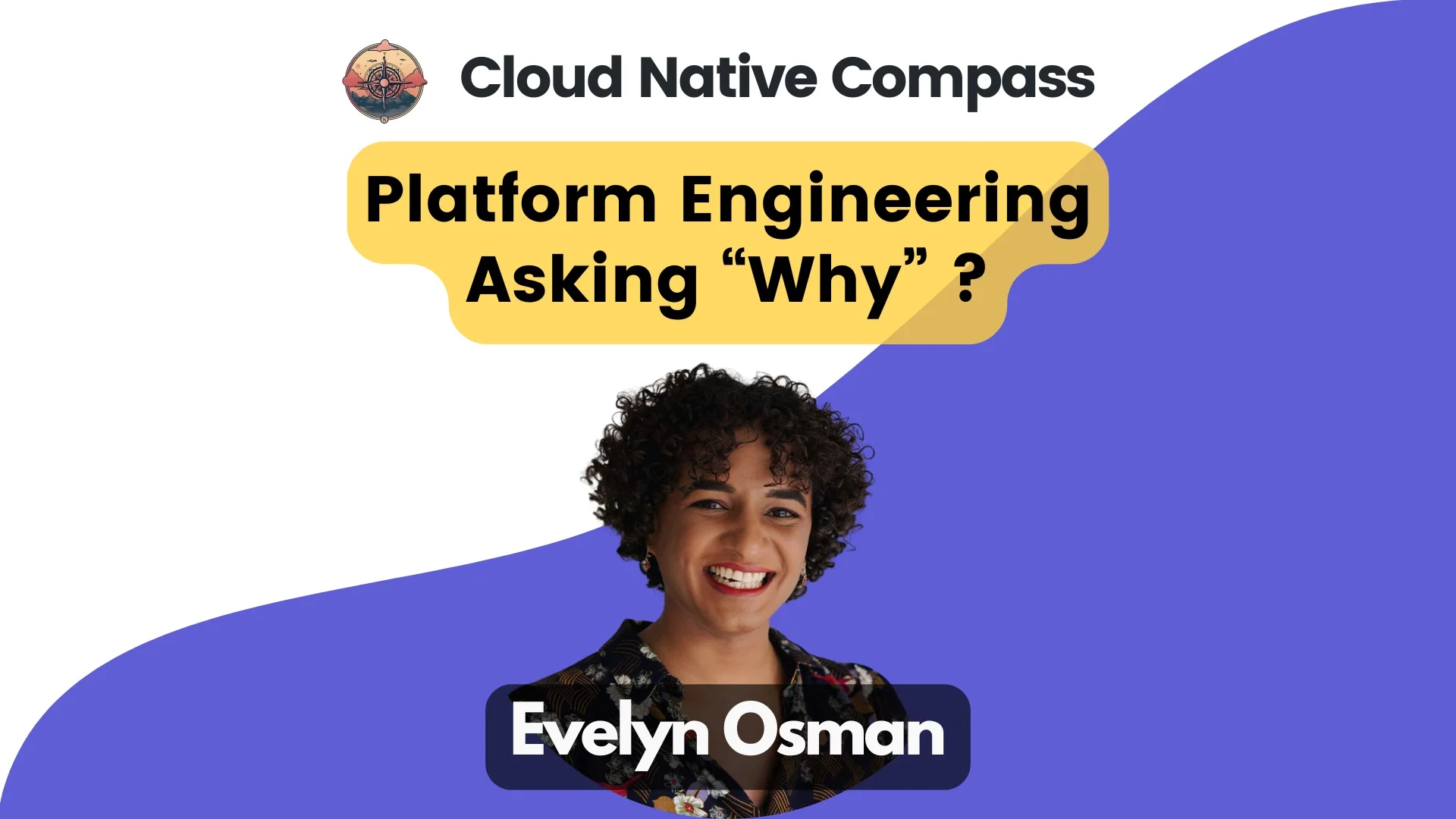
Platform Engineering: Asking "Why"? with Evelyn Osman
Today we had some long conversations about Arc Bash and the future of scripting as well as platforms and the rise and fall of Kubernetes.
- Date
- Runtime
- 43:56
- Share
About this video
What You'll Learn
- How to question platform decisions by asking why each service needs Kubernetes, microservices, or heavier operational tooling.
- When building platforms, Evelyn explains tradeoffs between full Kubernetes fleets, VM or bare-metal hosts, and container-only alternatives.
- They also cover practical release strategy choices, including decoupling CI from CD to avoid tightly coupled deployment workflows.
Evelyn Osman joins David and Laura to defend AWK and Bash, argue platform engineering must start by asking "why", and pick apart whether every workload really belongs on Kubernetes. Also covers decoupling CI from CD.
Transcript
Generated from English captions. Select a timestamp to jump to that moment.
Read and search the transcript
0:00 laura--she-her-_2_07-23-2025_114939: Today we had some long conversations about Arc Bash and the future of scripting as well as platforms and the rise and fall of Kubernetes. rawkode-host177_2_07-23-2025_174940: The fall of Kubernetes. Hmm. I'll have Claude write a new one. laura--she-her-_2_07-23-2025_114939: Of course you will. I'm sure you were in the middle of telling Claude to do that during the recording. Actually, our guest, Evelyn Osmond spoke recently at Cloud Native Munich about. All kinds of good stuff, including whether everyone needs platforms and asking why. She also got into a long conversation with David on Blue Sky about a. rawkode-host177_2_07-23-2025_174940: We decided that you need to
0:34 be this old to know what a is. So if you're as old as us, you pass the test. laura--she-her-_2_07-23-2025_114939: We also discussed why, like the question why is the most important skill you should have rawkode-host177_2_07-23-2025_174940: Like, why are we using Kubernetes? Why are we paying for the clothes, and why are you listening to this? laura--she-her-_2_07-23-2025_114939: that last one. Maybe I don't have a good answer for. the episode. David Flanagan: Welcome back to Cloud Native Compass. Today we are joined by Evelyn. Evelyn is the head of platform likes oc, which is why we're here. I'll get into that more in a moment.
1:09 But, uh, before we talk about fun, command line shenanigans, platforms, operations, and anything else grabs our interest at the session, could you please take a moment just to say hello to our audience and introduce yourself? Evelyn Osman: Yes, thank you, David. Yeah, so as, uh, as I said, I'm the head of platform at, uh, energy Trade Startup in Munich, Germany, uh, called nac. Uh, so I've been there since last end of last year, uh, working to write a topic, so like building up the internal platform, you know, basically the platform engineering setup with, I do the platform with a product.
1:39 So the idea is like, you know, everything we build has like. Users functions, use cases that we support. Um, I also kinda the whole thing of like, we should be honest and actually at some point we look back and beside like, actually this is a bad idea. We should do it over again. You know, we'd always be honest, um, like avoid that the, the graveyard as much as possible, so to speak. Yeah. Um, yeah, and I guess maybe some things I'm working on recently, I guess, uh, so I guess I'm diving more into like, sort of like release management is, is one thing.
2:08 Um, another one is sort of like, you know, like data architectures, how to improve those, make more reliable, but that's sort of like more like, you know, bringing in best practices. Um, yeah. And, and I guess the other thing. Uh, I've been working really high for a very long time, so I'm actually thankfully finally getting back to actually writing code, which I'm very happy about. Um, avoiding vibe coding as much as I can. Sorry if I brought it up, but I, I'm, I don't, I don't use it. I just don't. Laura Santamaria: As David looks off screen at his
2:38 David Flanagan: It's still going. It's still going. Yeah. Laura Santamaria: Very nice. Well, good. David Flanagan: All right. Now, uh, let's not start the podcast by dating you, but we, we started talking and this, this podcast came together. 'cause I was talking about a and how powerful it is and I feel like. And today's day and age, and I said, I got an old manual on that cloud already. Right? Not a lot of people are really playing with a and said, and even regex to some degree. It seems to be people that have been doing this for a while that are
3:08 familiar with these tools because at one point that's pretty much all we had. So I'm assuming you've been doing this a well, you've used a, you like oc, you're probably a tinkerer and a script writer. So maybe you can give us a bit more history on you, um, with regards to these tools and what you've been up to over the however many years you've been doing this. Evelyn Osman: Yeah, so I actually, I started working in tech in like 2006, 2007, when I needed to pay the bills, you know, based like, you know, like good old
3:34 American, you know, college, you gotta work your way through it to pay tuition. Uh. And, and so I just was like, uh, you know, I basically worked a lot of different jobs from like desktop support, help desk. I actually, at one point I was running a, I was managing a data center, um, like a lot of different things. And so as a result, you know, I was doing a lot of, you know, like basically sitting in a console a lot of the time. Um, and with, with ok it was like, uh, actually at the time I was working for
3:59 a company that did a lot of like, you know, data streaming data, data analytics. And so we had just these like, um, I think at the time it was, it was Cloudera. Or, and, and Horton works. So it was both of those, you know, like Hadoop clusters and we were like basically working in a demo. And one of the things was basically like, okay, we actually wanna just basically like consume, you know, all the access logs from Wikipedia every day and we're gonna do some manipulation on it and transformation and then we're just gonna dump it into Hadoop and then do some analytics for
4:30 some, for some pretty dashboards with heat maps and NLP and all that crap. Um, and I ended writing. Everything in a, um, I, I, I don't even know why, why I did it. It was, at first it was like, okay, I need to start parsing things. Okay, now I need parse. Okay, I gotta iterate through it. And I was like, can I do this in a, and the next thing I know, I had like a, like a 200 line, um, script. Laura Santamaria: I love it. David Flanagan: I mean, there's gonna be people listening that just
4:59 think what You can write a scripts. It's not just print dollar one, et cetera, or, you know, field separators like, but yeah, it's, it's so powerful. So. Evelyn Osman: Yeah, like I do a lot of conditional, usually when I'm using OC and stuff or like, um, yeah, and, and it, it, it's something interesting because like I kind of saw. Uh, like you kinda mentioned, like, you know, like angry man yelling at cloud and stuff. Uh, but I kind of observed this like over the years as like, you know, cloud became a thing. I always say like, I was like with my company for, for my team, like three
5:29 people sat down, we should use AWS and I was like, no, we should not has all these IO performance issues super inconsistent. We do like data analytics. It's a terrible decision. Um, two years later I was designing like an architecture for one of our platforms. Um, so you kind of saw how that went. Um, but I kind of started seeing like people, like, like learning, like understanding less and less about what was happening behind the scenes. And first it was like, you know, like architecture, infrastructure, you know, okay, I'm creating a PPC with subnets. I'm like, okay, how do you do subnetting?
6:00 They're like, I don't know what that is. They're like, okay, tell me about T-C-P-U-D-P. They didn't know what that is. Um, and now, and now it's kind of like gotten to the point where I see like, like they don't know how to write a script. Laura Santamaria: No, they don't. Evelyn Osman: Uh, and, and they're, and I'm just, I'm like, I'm like, okay, but I'm usually just writing little scripts. Like, actually coincidentally last night I was talking to my wife about the Cloud Native summit that I was, I spoke at yesterday in Munich, and I was just kind
6:30 of like, you know, very high energy. Came back from, you know, the conference talk high. Um, and I started chatting about all these things and I started explaining it like, oh, Python scripting, and I do object oriented. And she's like, what is that? And I just whipped up my laptop and I just started writing her Hello Worlds and like Bash and then Python and showing her the difference. And she is not a technical person. Laura Santamaria: I mean, when you're on that conference, talk high though. Like it doesn't matter. You're gonna show whether anybody gets it or not.
7:01 Evelyn Osman: Yeah. And like, like, and bless her heart, she was like really focused and listening and yeah. And like, she, she's, she's amazing. I just, I'm just gonna say like Right, right, right up front. Um, yeah. But, but like, I mean, like, but I'm like looking, you know, back into like where I work and like where I previously worked is, um, like, uh. You know, in this day and age, a lot of like managed services, everything's in the cloud. We're kind of pushing people more towards like, can you do programming? You know, and that's kind of pushes people toward, towards like
7:30 Python type script and everything. And it kind of leaves behind, um, bash, which, uh, kind of has like a negative reputation or stereotype in some cases. Very well justified. Um, like I, I have seen a script that was basically piping echoed to cat, to gre into said, and then finally into a, and I think they were just grabbing things from like Stack overflow or something. Laura Santamaria: Okay. David Flanagan: Uh, stack. Laura Santamaria: Yeah, I mean like, oh. Where's the difference now between like these AI generated code things and just copying from Stack Overflow? Right.
8:14 Maybe. Maybe. Evelyn Osman: I, I, I wanna say, Laura Santamaria: David A. Little bit, but yeah. Evelyn Osman: I'm, I'm gonna say like one of them is like very enthusiastic. I've seen like, yes, this is correct. And the other one is like, I don't really know why this works, but it works. And other people are like, yeah, it's weird, but it works. Laura Santamaria: Right, right. Evelyn Osman: they're honest. Laura Santamaria: Yeah, I love those answers on Stack Overflow. The ones where it's like, so if you do this and you shake this bell over here near the computer on this side, somehow magically it works, but you'd
8:45 have to press this Konami code into your terminal and it just magically works. Don't ask me why. Just use that. And everybody's like, yes, plus one. This works. This fixed everything. I love those answers 'cause it just never makes sense. Evelyn Osman: time I found like an undocumented like flag for Tomcat through a stack overflow that fixed my issues. David Flanagan: I Laura Santamaria: I love it. David Flanagan: mean, stack Overflow used to be fantastic, and there was a lot of knowledge on there. I'm not surprised that AI models are now, I, I assume they've been trained
9:17 on the majority of Stack Overflow, but while there is a lot of, no, there's a lot, but it's a small percentage of the content on Stack Overflow. It's good. I can also imagine that it has a very net negative effect on AI model training because there's a lot. Outdated garbage on there too. I mean, I haven't been on Stack Overflow for probably 10 years, and every time I look at my profile, because sometimes I still hit my own answers, which is really annoying, uh, it still says I'm in the top 2% of people that answer questions
9:43 and I haven't been on it for a decade. So Evelyn Osman: No, that's, that's true. I, I still occasionally just get badges from Stack Overflow, like I haven't touched in, so. David Flanagan: your prized possession, but you have to print them out and put 'em on your wall. So, um. Laura Santamaria: There you go. David Flanagan: Uh, I think what I enjoy so far about your, you know, your history and your context and where you are today, right? Is that you quite clearly are like a T-shaped individual, a curious individual. I, I prefer to say, I know T-shaped is probably a very lowy term these days, but
10:14 you know, you like to learn lots and lots of things, and I'm sure you go deep on certain aspects as well, but I also think that that's a dying breed in these day and age, even more so with ai because people don't really need to learn anything. I mean. There was that new warp terminal announcement last week where it's like just push tab and tell the AI what you want to do and like people use it to run ls. At least one of the demos was list of files and this director, and I'm like, that took four seconds.
10:41 Laura Santamaria: Are you kidding me? David Flanagan: Yeah. Evelyn Osman: like, have they not heard of CSH or are they not? Like once again, there's so many tools that do this for you. David Flanagan: And while I am very much on board with AI augmented programming, I do it every single day. I am having it do the things that I don't want to do, but I'm not having it do the things that I'm quite clearly capable of doing immediately, like running l. So, um, yeah, I think the way that developers, and I don't know, I'm way off
11:10 track now, but I'm gonna bring it back. It's like, I think it's very interesting to see. developers now that are junior developers and, you know, mid-tier developers, they haven't went completely, you know, reshaped and being curious and learned a thousand different technologies because I think that by learning the wrong technologies, you understand and appreciate why the right technologies work, is that when they just go to AI and say, how do I, how do I build that data lake? Right? Um, hopefully that's something we can have a conversation on. Not that I'm fully good with this stuff.
11:41 They just get an answer. They take it as gospel. That is the one, and they haven't learned a thousand other ways that it didn't work and why they got to this one. And I'm very worried about that aspect of how AI is gonna change. And we can loop it into platform engineering too, right? I'm sure there's a lot of people out there today that just go, I want to build a self service platform from my developers. And they say, Hey, you need backstage with Kubernetes and microservices. And then they just go and push per. Have I write a manifesto, email it to all the execs, get buy in,
12:09 get a hundred thousand dollars bonus, and then job done like this. I, this is, this has the whole world of being potentially bad. I dunno, there's not even a question in there, but you know, let's. Evelyn Osman: Yeah, no, I absolutely agree. So, so like, um, so like in this talk, I, I do, you know, like I have someone I put together last year for a meetup and I've managed to give it at two conferences. I don't know why they said yes, but they said yes. Um, it's, you know, like for, for, for people listening,
12:34 like, I have this talk, I say. Converting a platforms where every organization eventually builds a platform without really intending to or, or wanting to. Um, because it's basically at some point they need to have some commonalities in what they're doing. Um, and, and, but, but then, and that I kinda also kind talk about how do you actually make succeed and what are your common, like dead end. Um, in it. And one of the things that I really kind of hammer, uh, when I'm talking about, you know, you eventually end up with it because organizations are
13:01 kinda like, you know, they're chasing that revenue, you know, dream of like, I'm gonna, we're gonna make so much money if we deliver this really fast. And they kind of forget that there's also people working there. And so like, we're gonna do agile. And we'd be like, okay. Like, but we still want rigid timelines and we wanna have a focus framework for planning everything out. Like that's not agile. And eventually, like we're gonna do Spotify model 'cause it helps you be autonomous. But we're gonna do lots of check-ins with every single guild and chapter to make sure they're doing the right work, not autonomous.
13:29 Um, and then we're gonna do a team in topology. 'cause it makes things better. It fixes all the, all the issues you have with the, with the Spotify model. But we're gonna do all these things. I'm like, well you're still kind of breaking it. Um, I can go on forever about this. Um, but, and, and so, uh, and it's only when they kind of realize like, oh, we should actually be empowering them to actually make things, make independent decisions, but also make decisions that follow what we want, that golden path that we all talk about.
13:53 Um, anyways, so, so, so one of the things I always kinda hammer is like, think about the people, but also think about like the why. Or the motivation. Um, like I always, I always talk about the golden circling from Simon Sinek. You know, it's like, it's easy to define like the what, like what are you doing? We're building a platform. How are we gonna do it? Uh, we're gonna do Kubernetes with Backstage. You know, we're gonna use Datadog for some metrics, and you click a button, you got everything running with all your metrics and SLOs.
14:18 I'm like, well, why are you gonna do that? And oftentimes they just, they just don't. Um, and, and I think, and I think that's, that's like also kinda an important thing. We're kinda looking at like, um. Like people relying heavily on AI and like, you know, like there's not really that cur, I think there still is a curious side of it, but the curious side of it tends to get reinforced by AI saying like, this is a great solution for you. this one. Like, oh my God, thank you. You just saved me so much time.
14:45 And then five minutes later it's not working. Be like, okay, all right, ai, what up, what else should I do? Like you should do this instead. And like, thank you so much. You've made my job so much easier. Um. And, and so, and, and the thing, it's like, I, I kind of like when I say like your platform as a product, it's because I always kind of try to break things into like doing some like discovery, you know, doing some tinkering. Um, like I do the whole diverge, converge, like figure out, like we build a hypothesis, what we think might work and then we just like explore what
15:15 solutions might work for that hypothesis. Um, and then we just try them all out and then we eventually figure out like one or two that actually makes sense and then we just kind of go with those. Or we pick one of the two and go forward with it. Uh, and, and I think that's, that the thing that's kind of thing that I'm kind of seeing missing is, uh, 'cause people they rely have so heavily on just getting an answer that they forget that there actually are multiple answers that they should actually consider. Laura Santamaria: Yeah.
15:41 David Flanagan: Right. I've got two points on that because that was fantastic. Right. And the first one is, thank you for mentioning Simon Sin Nick, because I don't think we've ever mentioned why or Simon on this podcast before. Is that right? Laura and I will single-handedly say, because probably the most important book I've ever read in my life, because it touches every aspect of my life. And I'll give more context in that in a second. It's like. When you read that book, you can apply it in your home life, your family life, even my paid it in life, my work life, everything.
16:12 Because just asking that one simple question of why are we doing this is really important. And the reason I think it's important in this specific conversation with, with platforms and, and engineering culture in general is because. All the things, all the tran not, that's not the right word. All the waves we've seen right over the last 20 years, whether it be agile, DevOps, platform engineering, observability, um, SRE, GitOps, I mean, I could list them all, but we'd be here for a while and it wouldn't be very entertaining. Well, I mean, hopefully it. Laura Santamaria: It might be.
16:47 David Flanagan: I could like, bring in a costume. Um, no, like all of these different, I don't want to call them movements, um, patterns, uh, themes, whatever. Right? They were all. To some degree we bottom up and that the people doing the work understood the why and they were very successful, but then they crossed some sort of chasm and then they become this top down thing across organizations. And I think we've seen that with, especially team topologies, right? I don't think it had a lot of bottom up movement. But Agile did. DevOps did Kubernetes, that Cloud Native microservices did.
17:20 You know, it gets to a certain point where it gets so popular that the reason and the why is lost and it's just pressure from C-Suite pushing down. We need to be agile for. Capitalism and oh, we need to be microservices, the Cloud Native 'cause. Well, capitalism and when the why is capitalism, everything falls apart and it doesn't work. But these bottom up movements when people like yourself understand why we need to do this, and they're pushing for agile and they're pushing for platform and all the constraints and the motivations are right, teams are gonna be much more successful.
17:51 That was part rant and part context, but. Evelyn Osman: Yeah. Laura Santamaria: Go ahead. Evelyn Osman: I need to like sit with that for a second. Uh, no, I, I, I totally agree. It's because it, it was always like, uh. Oftentimes, you know, when I'm pushing back my, I'm, it's, it's funny, like I kind of like built this reputation, uh, where I am right now of like, like, oh, Evelyn loves structure. I'm like, no, no, no, no. I just wanna know, like, make sure we understand the why we're doing this and what, and how we're gonna accomplish it.
18:21 So it meets, I wanna, I wanna make sure it meets, um, because oftentimes it's like, ah, we need to, like, we need to react to this, so we gotta tackle this thing. I'm like, okay, but. Can we actually like walk through that and really kinda like, consider the options a bit? Um, and, and it is interesting 'cause like oftentimes when, when you're somebody who's like, okay, let's actually understand the why and like, really discuss this and figure it out, you know, so like, you know, let's sit down, like spend an hour just like charting out.
18:46 Like what are the opportunities here and why do those matter to us? Um, and then we kind of fit, and then by the end of it, we kinda like developed, you know, that hypothesis, that value proposition, that kind of helps find the motivation within everything. Um, and, and oftentimes like people think that's like, um, I don't wanna say convoluted, um, but it kind of slows us down, you know, kind of becomes, creates this very complex process. But really it's sort of like, you know, like, do we actually understand our users and what our users want?
19:13 Um. Laura Santamaria: I mean, the thing is, is that, so, uh, full disclosure, I currently live with an engineer. Uh, he's a computer engineer, software engineer. And so, um, I have a very different perspective, I think, than a lot of people who came maybe out of a CS degree. There is a lot of engineering that goes into doing engineering. What I mean by that is that it's not supposed to be fast. If you're going that fast, you're not thinking through everything. The point is of engineering is going through those why's. It is thinking through your architecture, it's thinking
19:48 through what you're building. Are there alternatives? Why are we doing, why are we picking this one? Can you give an answer to that question? And I've seen not only him, but then some of my mentors back when I first was getting into tech, were. Straight up engineers, and I'm talking like they're from Canada and they have the engineering ring and they get really, really picky about you using the term software engineer when you're not actually an engineer. They're those people. I love them to pieces, but my point is, is like they're really into it and
20:19 they would always be like, Hey, wait a second, we need to think this through. It's amazing how when you have somebody like that doing this and you're talking about all of those why's and all of those things, suddenly magically, everything usually comes out and works. It might have some bugs, but it actually works. Instead of this move fast and break things mentality where we just kind of throw it together and say, does it work? Shove it out the door. Oh look, it broke. It's not like that. It's more you're thinking it through. And so I don't know.
20:50 I lean more towards that engineering side. 'cause to me it's more like the scientific method you're going through, you're testing your hypothesis, you're tr trying this saying, okay, it kind of works. Let's build it. Let's see if that works. Okay, here's another option. Here's another option. Here's another option. Let's go through and pick the best one, not the one that chat GPT told us to use yesterday. So, I mean, to me it's, it's engineering. That is what engineering is, is going through and thinking all of that through and trying all the options before you build something.
21:25 David Flanagan: Yeah, I mean. To, to, I dunno, triple down on this. Right. Evelyn said something. Evelyn Osman: I. David Flanagan: I think we're all, we're all Laura Santamaria: you wanted. David Flanagan: we're all in agreement. You've now double clicked on that and I'm never gonna say that again. I may even edit that one out. I know. Let's zoom in on this, but, uh, no, what I mean is like. I completely agree with why Evelyn is saying this, because you need an Evelyn on your team, right? We need to understand why it's so important. Otherwise, what we end up with is, and we've seen this many times, I'm sure
21:58 we've all seen this, right, is where Google releases something because they do something internally and then a whole bunch of engineering organizations who want to aspire to be more like Google, adopt it without understanding why they actually go down that road. And then that's when the problems come down. And it's the same reason, the same thing with platform engineering. Evelyn made the right decision to ask the questions of why do we need a platform? What really happens? And a whole bunch of other organizations where people aren't asking these. Basic questions, really, right? Everyone should understand why they're doing what they're doing.
22:27 Um, they end up with the same copy paste, nonsense platform because they've been told that by the people selling the platforms, right? Like, I wouldn't name any companies, but they come along and go, Hey, you can have self-service, this, this, and this. Oh, okay, let's, let's install that. Okay. Did we need self-service? Or did we need something else? Did we need a platform because we want to be able to spin up new microservices and reduce boilerplate. Should we be handling code generation and templating separately? Or is it because we need better secrets management? Or is it because we need a single plane of gas and then, uh, of observability
22:58 across disparate clusters and disparate regions and disparate clouds? Uh, but oh, no, no, you've, you've now got backstage and it's got a little box where you can just say, you know, deploy it in your application. Like the needs and dependencies and the constraints of every organization are different. I'm not saying they're snowflakes, but they are different. And when you have to understand the motivations, if you want, not just make your developers happier because they understand why they're building what they're building, but because your end users are also gonna be happier because you're solving real problems that they have, and not just
23:25 giving them more cognitive overload of, now I need to learn a new thing, and I didn't have to do this before. Sorry, I keep ranting today. It just. Laura Santamaria: You're good, but, but hold on. Evelyn, you said that you wanted to descent. I'm actually curious. No, no. This right? Evelyn Osman: Yeah. Yeah. So, no, no. So, so, so like you, you, like we've all heard thinking like, oh, this is super over-engineered, uh, and. And so, and so, like, I, I agree. You know, like engineers, like they're, they're generally very methodical about how they're building something, but the, the risk, I mean, this is always, you
23:58 know, I, I got God, I can tell you so many stories about ridiculously, I've heard leaders say, um, where it's like, ah, well we need leaders to help with this problem. Um, so, but it is really that, like I. When an engineer starts tackling a problem, oftentimes they just have the requirements and they start running forward with requirements, and they'll build you an elegant solution for those requirements. But there's no point where it was like, okay, well why are these necessary? Um, or they'll wanna be like, or they'll design to make it future proof. You know, to be like, okay, we're gonna go, you know, full
24:31 on adapter focus so we can like, swap all the different components. We're gonna do, like platform agnostic. We're not gonna adopt anything directly. Okay, we're gonna use like the latest, you know, um, know, tech stack, da da da. Um, and so that's where like, you know, they're very method about planning it out, but they can oftentimes just kind of get very distracted. Laura Santamaria: Yeah. Evelyn Osman: By how? By the right, by what's the right way to do it? And that's why I always say like having that why of like, okay, well why do I wanna make these tech choices?
24:59 Because I remember like a couple years ago I had an engineer, I was like, okay, I want you to use fluent D to basically do some log shipping over to Kinesis Stream so we can basically publish our logs into New Relic. Um, and then like two weeks later, he came back to me and he is like, here's a solution. I'm like, where's fluent D? And he is like, oh, well I wanted to use this library because I can do all these other things. They're like, but we we're never gonna need to do any of those other things.
25:21 And now we have like this divergence from a standard and how we actually do, um, telemetry and log shipping. Laura Santamaria: I guess to me though, that's, that's a sign of a more junior engineer, Evelyn Osman: Oh, this was a senior engineer actually. Laura Santamaria: I know, I know, but I'm, I'm saying, to me, that's a sign of somebody who's more junior because they're not understanding that one, if someone tells you the exact tech stack they wanna use and you didn't question it when they gave that to you, you didn't ask why then. It's not your job to then go, just decide to go try something new and shiny.
25:54 That's not how the job works, but it is your job when you first are assigned those requirements to go through and say hi. Where did these requirements come from? Let's have a conversation. Let's understand why these requirements are there, because a lot of times there are cases, and I've been hearing a lot about some of them from some of my friends recently at one company that I talked to, they. Are getting requirements from product, but it's literally the requirements that the customer is giving them. But the customer doesn't know what they want. They say they want this, but then the engineer's job is to question
26:30 and say, so why are we doing that? Why are we building this that way? Otherwise, you're reinventing the wheel, or you're not considering this solution, or you're not considering this possibility. And that's the conversation that should be had at the very beginning Evelyn Osman: I agree. I agree. And that's actually one of the, we oftentimes see like, you know, engineers are so exhausted of the product 'cause product, they're like, we want you do this. Like this is ridiculous. Doesn't make any sense. And the customer asks something that's like, unachievable. Uh, so I think it's like, I just, why say like everybody
26:59 should be asking this question. Why? So when the customer goes to product or the product talks and be like, I wanna have be able to do this. I'm like, okay, well, like what would this actually make easier for you? You know? And this is why I'm always talking about jobs and functions, you know, it's like, what job are you trying to perform? What functions does that job satisfy? Um, and oftentimes when I'm sitting, I'm talking about jobs, you know, I'm like, okay, what jobs is, is the QA person trying to solve? And I'm like, well, the QA person, they just wanna test the software.
27:24 Like, no, no, no, no. The jobs are actually much more human at the end of the day. You know, like one job you wanna perform is to go home happy. Laura Santamaria: Yeah. Evelyn Osman: And, and people kind of tend to forget that aspect because that's why I was say like, kinda like, you know, like think thinking about the why from like all across is really helpful. Um, but it's always like when engineer has a requirements, they're gonna be thinking like, why these specific requirements? How often teams would it be? And so that's why I said, you know, I kind of call like the holistic view of like,
27:53 you know, kind of like jumping across like the whole spectrum of like what actually makes sense to build for us at this time. That's why with a platform engineering, we always say, you know, you wanna build things, um, the right way, at the right time with the right people. Is is one of those things. Um, yeah, and I think it's, it's kind like that's why I was kinda dissenting when you were like, engineer is so great, methodical and figuring things out. I'm like, can go a bit sideways. Laura Santamaria: That that's, that's fair. Like, I guess maybe I just have a very, uh, very rosy view of engineers.
28:25 'cause the engineers that I engage with usually are like staff plus, and they spend a lot of time having those conversations that you're talking about, not. I'm gonna go chase the new shiny thing because it's fun and I get to go build the thing and I'm gonna go future proof it to the nth degree and all that. No, they're usually much more down to earth and thinking things through. David Flanagan: Not Laura Santamaria: Who knows? Well, yeah, but you, we've already established that you don't have an engineering degree, so wait a second here. Um, David Flanagan: I mean, I almost canceled this dream to go play
28:56 with a new shiny technology. So, Laura Santamaria: I know, I know. I know how you do things. Evelyn Osman: I would've had like much forever. David Flanagan: and, and my defense, I'm the only person responsible for my production infrastructure. So it's, it's my sleep that I compromise every time I play with something Cheney. So. And that's a load. Yeah. Laura Santamaria: you go. Yeah. Yeah. As long as you're not, you know, giving somebody else the, uh, 2:00 AM pager David Flanagan: Yeah, could you imagine that If someone hired me to help them build their Kubernetes platform, and I was like, here's all these alpha softwares.
29:25 Good luck. I'll see you later. I actually did that. I mean, I've done it a few times. I'm not as bad as that, but I was a big fan of Vector when it came out as an open source rust base collector project. I thought it was super cool. Um, and then the big purple dog bought it and swallowed it up and now I feel bad for any company. I've left them with that. I mean, it's still open source and it's still maintained and I'm sure it's still good, but you know, Evelyn Osman: Yeah, I remember last week actually implemented Vector
29:52 and that was, was one of the things like actually it's kind of limited now, but it still works really well. David Flanagan: yeah. Very cool Evelyn Osman: Yeah. But because I did, I have, I have a question for you actually. Um, 'cause one of the things I always see in the cloud in a space as people really drinking the Kubernetes Kool-Aid. Laura Santamaria: Yes, Evelyn Osman: It's, it's very much like people are going so hard on Kubernetes. Um, and I oftentimes I look at it, I'm like, okay, I understand the benefits here and how it helps us, but I don't find it as like the one size fits all solution.
30:25 I'm not saying we should go back, you know, to like, you know, running like virtual machines or instances and stuff like, you know, like truly and like face to front container on that. But I'm kind of curious what, what, what, what, what your opinion is on like. Where, where do you think like Kubernetes is not a good fit? David Flanagan: This isn't how Laura Santamaria: Go ahead, David Flanagan: works, Evelyn. Evelyn Osman: I'm turning the tables. Laura Santamaria: I. David Flanagan: So, I mean, uh, I mean I have been drinking the Kubernetes Kade now for, for 10 years, and I have everywhere I've went, I've brought it
31:00 and I used to try not do that, but the needs always were there and I always had really good story for when not to use it. So I'm gonna answer subjectively from that regard, but I think. And this is like my disclaimer, objectively, in 2025, every company should be on Kubernetes because you're losing out on too much now because everything is now leaning towards Kubernetes native, and all the examples are on Kubernetes. So even if you've just got a Java monolithic application, no, you should probably still run that in Systemd, but whatever. Like if you go by Kubernetes, you do get log collection.
31:35 For for free. Right. And you guess you can have GitOps for free and you can have observability pipelines using Prometheus service monitors for all. All this is for free because it's free to learn how to do it. And the examples are all there, but there's still the tax, right? You still pay a Kubernetes tax. Um, but there are, so it's hard for me to say don't use Kubernetes. 'cause I really do think it's like you lose out in too much now 'cause it is the defacto, but. Java does not work well in containers. It's getting better.
32:05 Uh, I think if you're on Java 21 or whatever the, the, the latest and greatest is where actually respects Linux secrets. You might have a good time, but prior to that it was hell on Earth and the JVM just wasn't built to run that way. It does hop, hop code path optimizations over weeks and months. Container based workloads don't run for. Sometimes even days, nevermind weeks or months. So like you lo you lose a lot of the JVM performance tweaks by just not by, by doing Kubernetes, I, I say Java is usually a good one not to put in containers.
32:37 Uh, now with regards to not using Kubernetes, again, I'm struggling because I put everything in Kubernetes. Even if I've got single node clusters, I put stuff in Kubernetes just because I like the fact that it's a supervisor more than anything else. And it handles configuration and secrets. Even though I don't do a lot of, you know, most of, I don't really even have that many five node clusters because I just run single node clusters everywhere. It's just so powerful. Uh, I'm the worst person to ask this question too. I'm. Laura Santamaria: yeah. I mean. Evelyn Osman: Yeah, I, I, I really wanna kinda like twist the needle
33:09 a bit and see how you react. Laura Santamaria: I mean, like, the fact is, is so I'm the, probably the one who's a little more skeptical about Kubernetes being the solution for everything out of the two of us. Um, mostly because I, I don't like the idea that something is becoming such a defacto standard that is really a terrible way to host a static site as an example, like. I don't need that much overhead. I'd rather not. I'd rather not have things that go and break all the time that I had. Like there's all this complexity that Kubernetes brings in my
33:42 mind that isn't always useful. It really depends on what you're building and why, and why it's important that that's being built that way. Um, I don't see anything wrong with having a VM for something that is gonna be long running, that is going to be doing something that needs to be basically functioning like a single bare metal machine. me, that's really where like you're kind of trying to decide do you want microservices? Yes, most cases right now are microservice based, but do you need it? Is it always gonna be that way? There's some things that are just not gonna work that way.
34:16 Um, one of the really classic examples, I always think about banks. The mainframes that they run for. A lot of their heavy transactions really just do better to be left alone as more of a mainframe, whether that's a true mainframe, like more modern mainframe, or you're running on virtualization on hardware. To me, that is probably one of the bigger use cases. You don't need Kubernetes to be doing all of that. You don't need Kubernetes to be running all of those transactions all the time because you need it to be up and running. And why go through the whole process of trying to move everything to
34:52 Kubernetes because that's what everyone else does, or because it's the, everything is easy to plug in. Are we getting back to the same question of, oh, well this is what everybody else does. I'm going to just plug it in because I don't know how to do it any differently. That's a Evelyn Osman: no, I, yeah, I, I agree. And then this is sort of like where, like, I was like, because I'm almost like, like, why do we need Kubernetes? You know, like, or even like, why do we need to go all the way into microservices?
35:18 Like should we actually study more towards like, you know, intent driven, you know, development of services. You know, multiple. We don't really need to do, we don't really call 'em MicroSource at the end of the day. Um, now, now, so, so one of the reasons I, I, you know, I've kind of been like thinking about this, I'm like, oh crap, Kubernetes everywhere. Uh, so I mentioned early on that like, release management is one of the things I'm actually dealing with at the moment. And the biggest pain point isn't the, how do we do release management
35:41 is how do we decouple CI from cd. Uh, as, as a lot of the time I see everything is basically like heavily integrated now. We use the entire use CI systems to do all of our deployments. Um, and we call things GitOps that are really being GitOps at the end of the day. And that's actually where I see a lot of issues. You know, we guys say like. We tightly coupled, you know, the definition of infrastructure, what's actually the, the application being deployed. Um, and so one of the things I discovered when I was like, I was like looking
36:09 at the landscape, I'm like, okay, what are the options, you know, for purely CD solutions And like 99% of them were all just like built around Helm, for example, or an Argo cd uh, derivative. Um, and like, and, and then like I stumbled upon like Helm list, which is using a Google run. I believe behind the scenes, and I'm actually like very motivated to just like develop my own integration for AWS, um, and then just basically upsetting the Cloud Native spectrum just because they decided to do something that wasn't Kubernetes related. Um, and, and so, and that's kinda like one of the things where I'm like, I,
36:40 I feel that, uh, yes, everything is going towards Kubernetes, but not every use case actually makes sense for it. And we're actually, but we still wanna be container based. And that's where I kind of see like this. Like this, this chasm perhaps, or this disconnect, uh, of us, you know, how do we actually do like, you know, container driven solutions without immediately jumping straight into Kubernetes at the same time? Laura Santamaria: I mean, like right now I've been playing a bit with Pod Man and looking at that and they're like, pod man can do, uh.
37:17 Minor orchestration, I guess I can say. Like it's, it's, you can run multiple containers without necessarily thinking about adding an entire Kubernetes Cluster underneath it, which is kind of fun to poke at. Um, I don't know a ton about it in production, so you David Flanagan: It also has quads, which allows you to generate Systemd, uh, unit veils for pod man containers, which is also a really nice approach as well, as long as you're happy to stay on that kinda single node concept, which again, for most people is actually, it's fine. It's a good way of doing it.
37:46 But then you have to learn all this stuff yourself. Like, it's like, you know, USBC is everywhere. If you need to charge your phone, someone has A-U-S-B-C cable, right? And that's, that's Kubernetes in 2025. The minute you say, oh, well I just want to run a T that does MongoDB and I wanna set up automatic backups and I want to do geo replication and stuff, you, you're off the beaten path at that point. And that's why I, that's why I generally think that most people should be looking at Kubernetes for most use cases. Even though it's not the best approach, it's going to be
38:15 the easiest in no longer run, Laura Santamaria: Well, this is where I argue with you though, is David Flanagan: no. Laura Santamaria: I'm, I'm serious. Well, Evelyn Osman: opened the Can of Worms. I'm, I'm Laura Santamaria: I know, but. I guess. I guess my point is, I'm coming back to where we started this whole conversation of how much are you willing to outsource to other people? How much are you willing to outsource to chat GPT or to the experts at AWS or to wherever versus understanding how your system works in hosting your own stuff. There's lines and what are you willing to, what's the trade off here?
38:52 I know David, you're looking at it as trade off is. Kubernetes, everybody has everything everywhere. There's all these integrations. It's easy to plug and play. Just go. I am looking at, well, if I'm willing to hire the people who can figure this out, depends on the size of the company, depends on the size of the business, depends on what they're trying to do. Depends on like specific use cases. Maybe you'd rather hire an expert to be able to do those things and not outsource that expertise outside of your organization. Again, do you wanna hire or do you wanna spend money?
39:29 Do you wanna buy backstage or do you wanna hire to build your own platform that works the best for what you're doing? I think it needs to be an informed choice, and that's kind of where I look at. This is David. Uh, our TA classic argument of Laura looks at the business side of it. David looks at the tech side of David Flanagan: you've brought this back to CapEx versus opex discussion. Come Laura Santamaria: Ha, I win. No, I'm just kidding. Hey, I mean, you're the one who brought up rust earlier anyway. Um, David Flanagan: I didn't
39:59 Laura Santamaria: I think Yes, you did. You mentioned a rust collector. That was your David Flanagan: open telemetry collector. I never said rust. I haven't said rust today. Evelyn Osman: He, I did not hear rust. Laura Santamaria: I heard, I heard the fact that it is a rust based system with vector Evelyn Osman: Okay. That's true. That's true. He did. He did say that. That's true. Uh. Laura Santamaria: Anyway. So getting back to the point though, I think to me that's really the question that you need to think about is if, if you're looking at, I have
40:27 the money to spend and I can just outsource all of this to Kubernetes, to whoever, to whoever has it, to whoever can run it for me, et cetera, fine. But if you're willing to take the time to invest in it, maybe it's a better choice for your platform. And that's kind of where I get back to it. Evelyn Osman: Yeah, no. And then I think that, I think that's totally fair. 'cause it, at the end of the day, you know people who are. One run containers, they don't actually care whether it's Kubernetes or something else.
40:52 The one who cares about, it's one who's actually like, oh, wanna and maintain it. And it's a question of, you know, how much you wanna offload to another vendor to take care of it for you. Because I think there's, there's, there's so many, there are so many, so many vendors that literally all they do, they just like, we just run Kubernetes for you. David Flanagan: Yep. Laura Santamaria: Yep. Evelyn Osman: Yeah. And I think that's, that's, that's actually really honestly the other side of it. And that's kind of where I have been kind looking at it like, okay,
41:13 like this Kubernetes right fit. What, and actually, and then this even, I can kind of like turn the question back on myself. You know, I should also ask myself the why. Like, why am I so hesitant to go towards Kubernetes? Uh, and it might just be because I've gotten so used to this high level of abstraction or everything's managed that now when I'm saying like, okay, I need to do dec couple CI from cd. Okay, we actually need to stop defining. Application releases infrastructure's code. That means we be more, be more dynamic and have a system where can
41:39 actually dynamically pick up what the current artifact is to deploy. I'm, I'm already spelling out Kubernetes just by describing that. Laura Santamaria: Yeah, you never know, David Flanagan: All right. I need to schedule a follow up in three months and see if you've got Kubernetes in production yet. Laura Santamaria: Oh, anyway. But I was gonna say, you know, I'm watching the time and unfortunately I think we are very close to time. David Flanagan: Yeah. Again, we're not very good at cap keeping to that 20 minute mark. We're over 40 now, but I mean, it's been fun.
42:12 It's been so much fun. Evelyn Osman: I mean, my commute is one hour, so this is perfect for me. Laura Santamaria: you go. There you go. See we're okay. Oh. David Flanagan: All right. Anything else we wanna discuss before we wrap this up? Evelyn Osman: No, I, I mean, I don't, I don't have any sales pitches unfortunately. Laura Santamaria: That's okay. It's all good. David Flanagan: All right. Well, I mean, thank you so much for taking time out of your day, uh, to come and talk about a and platforming and, you know, the rise and fall of Kubernetes.
42:45 You know, even though I've sat here and, and said that everyone should. It in 2025. That doesn't mean I'm not keeping my eye over here going, oh, what's next? Like, because I don't think Kubernetes will be the thing that we're still running in five or 10 years time. Maybe it'll just be cloud code agents doing containers. Who knows? But Laura Santamaria: Oh, David, David Flanagan: sorry, I'll see myself out. Laura Santamaria: should, but thank you for coming. This was a really good episode. I had a lot of fun. Evelyn Osman: Yeah. Thank you for Thank you for having me.
43:16 Yeah. And, and I'm gonna continue to be your reply in Blue Sky. Just like respond, everything you post. Laura Santamaria: Yay. Woo-hoo. Thanks for joining us. David Flanagan: If you want to keep up with us, consider us subscribing to the podcast on your favorite podcasting app, or even go to cloud native compass. Fm. Laura Santamaria: And if you want us to talk with someone specific or cover a specific topic, reach out to us on any social media platform David Flanagan: and tell next time when exploring the cloud native landscape on three Laura Santamaria: on three.
43:47 David Flanagan: 1, 2, 3. Don't forget your compass. Don't forget Laura Santamaria: your compass.
Technologies featured



Meet the Cast


Comments and resources
Comments
Documentation
Code
Additional Resources
More from Cloud Native Compass
View all 23 episodes
Navigating Kairos: Immutable Operating Systems with a Cloud Native Twist
Flatcar Linux: A Modern OS for the Always-On Infrastructure
AI-Augmented Programming
Observability for Developers: What You Need to Know?
The Future of Sustainability in Open Source
Atlantis: The Terraform Automation Powerhouse
Academy publications by email
Get an email when Rawkode Academy publishes new tutorials, articles, and videos.
Loading email signup. If it does not load, manage email preferences in account settings.