MinIO, we won't miss you.
MinIO just announced maintenance mode for their community edition — and honestly? Good riddance.
- Date
- Runtime
- 6:09
- Share
About this video
What You'll Learn
- Trace the 2019 and 2021 license changes that quietly hardened MinIO's codebase.
- See how the Weka dispute showed why public license enforcement can backfire.
- Understand how MinIO removed community console features and priced them at $96,000.
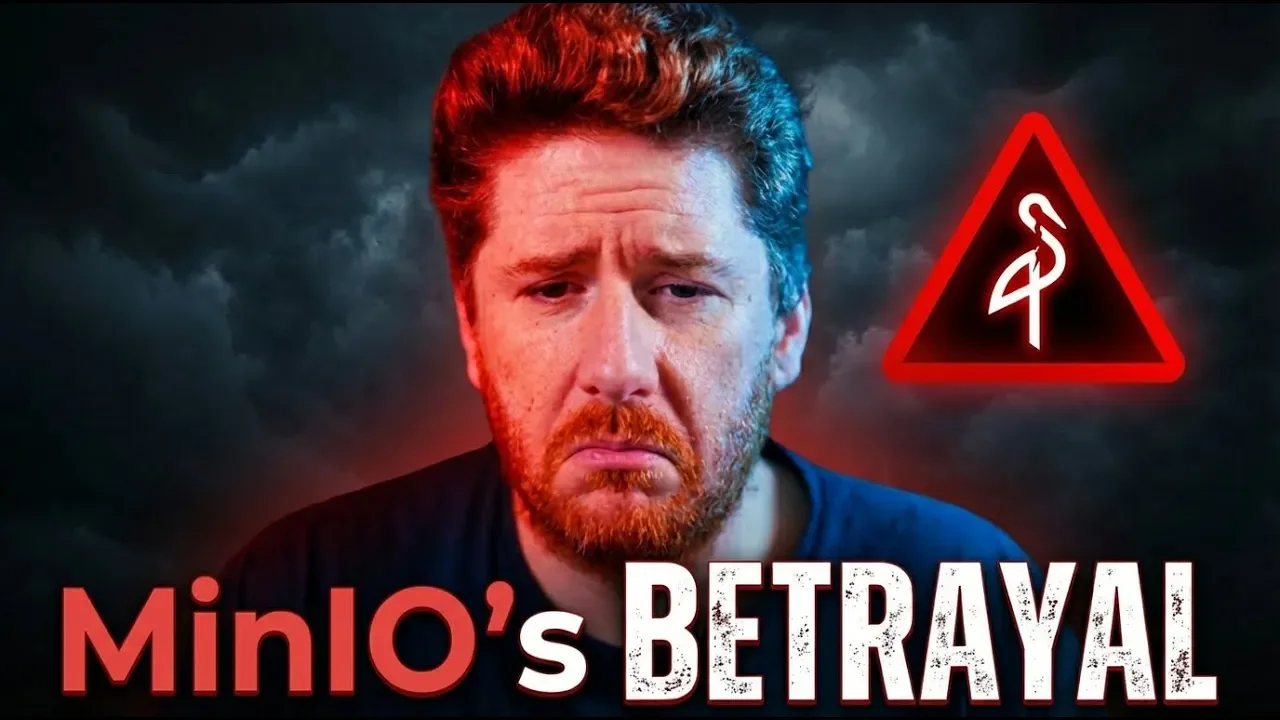
MinIO put their community edition into maintenance mode. We walk through how they got here: silent AGPL relicensing in 2019 and 2021, the Weka license-revocation stunt, gutting the May 2025 community console, and pushing a $96K paywall for features that used to be free.
Transcript
Generated from English captions. Select a timestamp to jump to that moment.
Read and search the transcript
0:00 Mineo just announced maintenance mode for their Community edition. Now look, I get it. Open source has to be financially viable. Companies need to make money to pay their employees who feed their families, and so forth. I'm not here to even pretend that everything should be free forever. However, the way you handle this transition really does matter, and Mineo, they've pretty much just shown us every which way you should not do it. Changing your license is totally fine, or at least can be totally fine. Plenty of projects have done it, some have done it well, however, we always remember the
0:47 ones that don't. In 2019, Mineo started quietly switching all the licenses on their auxiliary projects to AGPL. Still an open source license, not a bad license, but not as permissive as their original Apache two. Then in April 21, they changed the core server license as well. The problem? There was no heads up, no discussion. They just pushed the commit and hoped that nobody would notice. Fortunately, people do notice. Trust, it's not how you build community. In fact, it's how you burn both very, very quickly. Now enforcing your license is also completely valid. If someone is violating your terms, you have
1:37 every right to act. Going back to 2019, there was the case of Menio versus Nutanix. They got contacted in 2019, there were three years of private negotiations that, to the best of our knowledge, went nowhere. So in 2022, Menio went very public, very aggressively. What I will say is at least they did try, and three years is quite patient, you know? They tried to do the right thing the first time around. Fast forward though, and there was the case with Weka, and this is a completely different story. Manyone just dropped public acquisitions on a Friday
2:15 afternoon, no less, with zero contact with the company prior. They'd evoked their license, revoking an open source license, and then Hadley awkwardly walked it back just one week later when they realized, hold on a minute, we can't actually revoke an Apache two license. Like I said, this was just a publicity stunt and they're probably right, but industry experts and a friend Adam Jacobs said, and the link is below, this should drive everyone away from Mineo as a standard. And you know what, Adam? It's spot on. If this is not a red flag, what more do you need? Now the issue
2:53 here isn't enforcement. It's the whole shoot first approach and ask questions later, which again, trust, community, you cannot mess this up. Now here we are in 2025, and many old decides to focus on their commercial product, and that is a legitimate business decision. Again, sustainability is important. But here's where they fucked it up as well. In May, they gutted their community product, removing most of the functionality from the web console with no communication, no warning, no discussion. They took everything away except for the ability to browse objects within a bucket. And guess what, you can have those features
3:37 back, you just have to cough up $96,000 per year. What? Now people, the community raised their concerns on GitHub, and what did many of do?
Technologies featured
Comments and resources
Comments
More about MinIO
Academy publications by email
Get an email when Rawkode Academy publishes new tutorials, articles, and videos.
Loading email signup. If it does not load, manage email preferences in account settings.